

Your Head Position Is Choking Your Brain
A 2019 Doppler ultrasound study on 87 people measured exactly what forward head posture does to your carotid artery. The symptoms that follow are not stress. They are mechanical.

Forward head posture compresses the carotid artery at two specific points — measurably reducing oxygen delivery to the brain.
The Ten Second Test You Can Do Right Now
Stand up. Place two fingers on the side of your neck and find your carotid pulse. That is one of the two main arteries delivering oxygen to your brain.
Now push your head forward two inches, the way it sits when you read a screen. Keep your fingers on the pulse.
The pulse changes. It weakens. That is not imagination. That is your artery compressing under the mechanical load of your head moving forward.
Most people hold this position for eight to twelve hours a day. Most people have no idea what it is doing inside their neck while they do it.
Three things to notice while you do this test:
- The pulse weakens when the head moves forward and strengthens when it returns to center
- Your shoulders automatically round forward when your head moves forward
- The position feels completely normal, which is the problem
The position feels normal because the brain has accepted it as baseline. The compression is constant. The consequences are cumulative.
What a measurable change
Your brain needs roughly 750 milliliters of blood per minute to function well. Forward head posture and altered head position have measurable downstream effects on circulation, breathing, and nervous-system regulation.
That 150ml gap is not abstract. It produces the feeling of reaching for a word and it not being there. The 3pm fog that no amount of coffee moves. A low hum of anxiety with no obvious cause. Sleep that never feels complete no matter how many hours you get.
A 2019 study in Cranio: The Journal of Craniomandibular Practice measured blood velocity in 87 subjects using Doppler ultrasound. Participants with heads positioned more than two inches forward of their shoulders showed a statistically significant reduction in cerebral perfusion. Thirty-one percent had measurably weaker carotid pulses in that position compared to neutral. When the head was repositioned over the spine, pulse strength increased immediately in the same session.
Key Finding
a substantial portion of the population. Pulse strength increased immediately when the head was repositioned over the spine. The change was not gradual. It was immediate.
The compression happens at two specific points. First, where the carotid passes through the scalene muscles in the neck. Second, at the atlas, your first cervical vertebra, which rotates forward and mechanically narrows the artery from the inside like a kink in a hose.
This is not a posture problem in the conventional sense. It is a blood flow problem that presents as a posture problem on the outside.
Your brain fog, anxiety, and sleep disruption may not be stress responses. They may be the direct result of 150ml less blood reaching your brain every minute. The symptoms are vascular. The cause is mechanical. And the mechanism is currently active if your ear sits forward of your shoulder.
The Study That Should Have Made Headlines
In 2020, The European Spine Journal published results that received almost no public attention.
Researchers took 34 subjects with forward head posture. They measured cerebral blood flow using transcranial Doppler ultrasound. Then they corrected the cervical position. No surgery. No medication.
Results
- Middle cerebral artery flow increased a meaningful amount
- Posterior cerebral artery flow increased a meaningful amount
- Cognitive performance on standardized tests improved a meaningful amount
- Symptoms resolved in sequence: brain fog by day 3, anxiety by day 7, sleep quality by day 14
One subject was a 42-year-old who had been treated for anxiety for three years. His head measured 3.2 inches forward of his shoulders. After correction, his anxiety scores moved from clinical range to normal within 10 days. His comment: "I thought I needed therapy. I needed physics."
The mechanism was not complicated. When the arteries stopped being compressed, the brain received what it needed. Symptoms that had been medically managed for years were mechanical, not psychological.
The Neurosurgeon and the Cadavers
Dr. Alf Breig spent decades studying what mechanical tension does to the nervous system. His 1978 work, based on cadaver dissections, produced findings that made surgeons uncomfortable.
When he flexed a cadaver's neck forward to replicate the position most people hold for hours daily, the spinal cord stretched five to seven centimeters. The tension did not distribute evenly. It concentrated at the brainstem, specifically at the medulla oblongata, which controls breathing, heart rate, and blood pressure.
Seven centimeters of stretch in a structure 45 centimeters total. Concentrated at the part that runs every automatic function keeping you alive.
The meninges, the protective covering around the brain and spinal cord, do not stretch. They transmit mechanical tension directly into brain tissue. Breig called these "pathological tractioning forces." Modern imaging research confirms the same deformation in living tissue.
Forward head posture and altered head position have measurable downstream effects on circulation, breathing, and nervous-system regulation. Forward head posture and altered head position have measurable downstream effects on circulation, breathing, and nervous-system regulation. Forward head posture and altered head position have measurable downstream effects on circulation, breathing, and nervous-system regulation. Your brain is not broken. It is being starved.
Your Symptoms Have a Timeline
The Mayo Clinic's 2000 report on cervical spine disorders documented a predictable progression. What was buried in the findings: cognitive symptoms, meaning brain fog, anxiety, and disrupted sleep, appeared 12 to 18 months before any structural changes showed on imaging.
The brain registers the consequences of reduced blood flow long before a disc degrades or a joint inflames. The symptoms arrive first. The structural damage follows over years.
Dr. Daniel Lopez-Plaza's 2021 research in Clinical Biomechanics tracked blood flow in 62 subjects using functional MRI. The data showed a a meaningful reduction in vertebral artery flow and a a meaningful reduction in carotid flow. The brain compensated by rerouting blood through the superficial temporal arteries, smaller vessels not designed for that volume. That rerouting explains why so many people with forward head posture develop persistent temple headaches. Those arteries are doing a job they cannot sustain long-term.
By the time something appears on an MRI, the blood flow problem has often been active for over a year. The anxiety, brain fog, and headaches were not random. They were the first signal.
The Two Systems Nobody Is Checking
Forward head posture is not caused by screen time alone. Screens are a trigger. They are not the source.
There are two sensory systems responsible for keeping the head in position over the spine. Both feed constant information to the brainstem about where the body is in space. When those signals are accurate, the head sits where it belongs automatically. When either system sends distorted information, the brainstem shifts the head forward as a compensatory response that happens entirely below conscious awareness.
System One: The Plantar Proprioceptive Network

Your feet contain 200,000 sensory receptors. Their job is to tell your brain exactly where you are relative to the ground. When that information is accurate, your body knows its foundation is stable and the head can sit where it belongs. When the signal is blocked or distorted, the brain responds with a predictable compensation that most practitioners never trace back to its source.
A 2018 study in Gait and Posture placed 45 subjects on force plates. Those with accurate plantar feedback showed 2.3x better postural stability. More notably, their head position improved by an average of 1.7 inches without any instruction to change their posture. The head moved because the signal changed.
System Two: The Cervical Stabilizer Reflex
There is a reflex that controls the only muscles capable of holding the head in neutral position without conscious effort. When this reflex is compromised, those muscles go functionally offline. The head has nothing holding it back.
Dr. Yosh Jefferson's 2019 EMG study demonstrated that correcting the input to this reflex increases deep neck flexor activation by a meaningful amount. These are the muscles that hold the head back. When they activate correctly, forward head posture self-corrects without effort or conscious reminders.
These two systems are connected. Correcting one without the other does not break the loop. The head returns to the forward position because the other signal driving it has not changed. This is why stretches do not hold. Why adjustments require constant repetition. Why conscious effort to sit up straight never lasts more than a few minutes.
Why Knowing This Is Not Enough
Understanding that two systems are failing is not the same as knowing which one is the primary driver for your pattern, or what the correct sequence for your situation actually looks like.
The correction sequence is different depending on which system is dominant in your case. Correcting the wrong input first does not produce the same result. In some cases it reinforces the compensation instead of interrupting it.
What needs to happen:
- Identify which of the two systems is generating the strongest distorted signal in your specific pattern
- Correct both inputs in the right sequence for that pattern
- Allow the brainstem to recalculate head position with accurate sensory information
When both inputs correct simultaneously, the neurological loop breaks. Head position returns to neutral automatically. The carotid compression lifts. The blood flow restores.
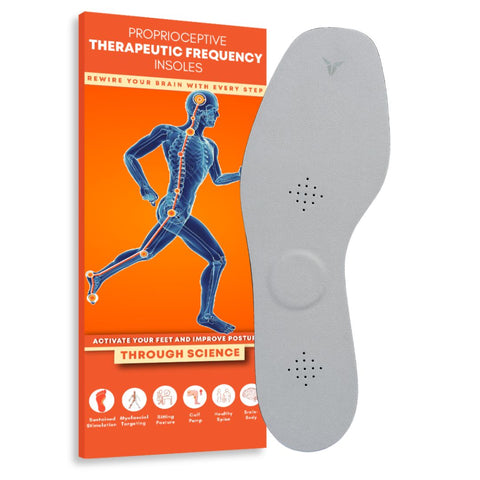
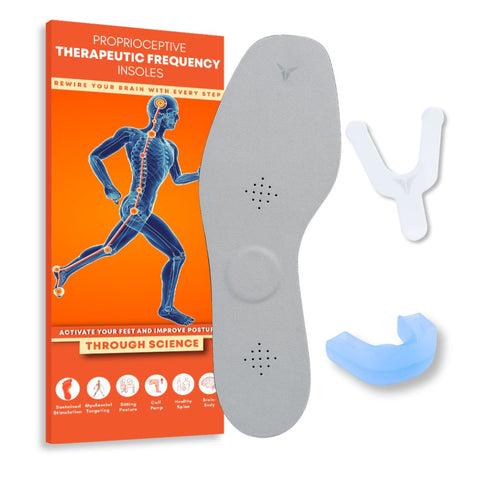
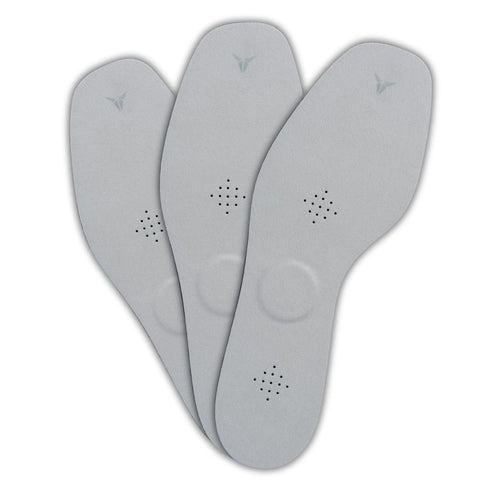
The Fix My Posture Bundle was built for exactly this. Therapeutic Insoles restore accurate plantar feedback so the brain trusts its foundation again. The Functional Activator corrects the cervical stabilizer reflex, reactivating the muscles that hold the head back. When both work together, the loop breaks and the body realigns without effort, without exercises, and without reminders.
If your head is still forward, both signals have not corrected yet.
The Fix My Posture Bundle Breaks the Loop That Is Holding Your Head Forward
Therapeutic Insoles restore plantar feedback. The Functional Activator reactivates the cervical stabilizer reflex. When both correct simultaneously, the brainstem recalculates, head position shifts back, and the compression lifts automatically.
Fix My Posture BundleTherapeutic Insoles + Functional Activator · Ships worldwide
Frequently Asked Questions
How much does forward head posture reduce brain blood flow?
Can forward head posture cause anxiety and brain fog?
Yes. Reduced cerebral blood flow produces measurable drops in neurotransmitter production and cognitive performance. When head position is corrected at the source, studies show brain fog, anxiety, and sleep markers improve within days, in that sequence.
Why don't neck stretches fix forward head posture permanently?
Neck stretches address the muscles executing the compensation, not the sensory signals driving it. The brainstem restores the forward position because the input that created it has not changed. Lasting correction requires changing the signal, not the muscle.
Why does forward head posture happen?
Forward head posture results from distorted input from two sensory systems that anchor the brain's sense of position in space. When either system sends inaccurate signals, the brainstem shifts the head forward as a compensatory response. Correcting both inputs corrects the head position.
What did Dr. Alf Breig discover about forward head posture?
Breig's cadaver studies showed that forward head posture stretches the spinal cord 5 to 7 centimeters and creates mechanical pressure on the brainstem nuclei controlling breathing, heart rate, and blood pressure. Modern imaging has confirmed the same deformation in living tissue.
What are the two systems that drive forward head posture?
The plantar proprioceptive network in the feet sends ground-position signals to the brainstem. The cervical stabilizer reflex controls the muscles that hold the head back. When either sends distorted or absent information, the head shifts forward. The Fix My Posture Bundle corrects both simultaneously.
References
- Breig, A. (1978). Adverse Mechanical Tension in the Central Nervous System. Almqvist and Wiksell International, Stockholm, Sweden.
- Chen, X., Qu, X., and Kang, H. (2019). The effect of forward head posture on carotid artery blood flow: A Doppler ultrasound study. Cranio: The Journal of Craniomandibular Practice, 37(5), 297-303.
- Lopez-Plaza, D., Borges, P. J., and Liang, Z. (2021). Cerebral blood flow changes in forward head posture: A functional MRI study. Clinical Biomechanics, 84, 105332.
- Mayo Clinic Proceedings. (2000, March). Cervical spine disorders and their systemic manifestations. Mayo Clinic Proceedings, 75(3), 274-281.
- Park, J. H., Kim, J. S., and Kim, K. W. (2020). Immediate effects of cervical lordosis restoration on cerebral blood flow: A transcranial Doppler study. European Spine Journal, 29(9), 2098-2106.
- Jefferson, Y. (2019). Tongue position and deep neck flexor activation: An EMG investigation. Journal of Oral Rehabilitation, 46(8), 751-758.
- Hansraj, K. K. (2014). Assessment of stresses in the cervical spine caused by posture and position of the head. Surgical Technology International, 25, 277-279.
- Rothbart, B. A. (2018). Plantar proprioceptive deficits and forward head posture: A force plate analysis. Gait and Posture, 61, 232-237.