


In this article
Why Your Neck, Shoulders and Hips Keep Tightening Up
Your neck gets massaged and your hips get released, yet by Friday the tension is back. Nobody ever checked your jaw.
If it keeps coming back no matter what you do, the Jaw and Body Connection course shows you how your jaw influences your posture and alignment, and how to identify the jaw imbalance behind your pattern. More on that below.
Stretching, strengthening, massage, adjustments: chances are you've tried most of them. You've pulled your shoulders back a hundred times a day and worked on your hips until they finally let go. Every approach promises relief, and for a day or two it delivers.
Then the stiffness creeps back. By the afternoon the neck is tight again, the shoulders have drifted up toward the ears at the desk, and one hip grips harder than the other every time you stand up. Some mornings even start with a jaw that feels like it worked all night.
If this sounds familiar, you're not alone.
Most people treat posture as a muscle problem, so they keep working on the muscles that feel tight. But when the same tension returns no matter what you do, the root cause is somewhere you have never been told to look.
What if the missing piece is your jaw, and the way your brain uses it to hold you upright?
In this guide, we'll show you how your brain uses your jaw to organize your posture, how a jaw pattern travels down through your neck and trunk to your pelvis, and why that explains tension that never seems to stay gone.
If you're tired of releasing the same muscles over and over, this is the piece most posture advice leaves out.
Understanding Your Jaw: More Than a Hinge for Chewing
The jaw joint, known as the temporomandibular joint or TMJ, sits just in front of each ear, where the lower jaw meets the skull. It works every time you talk, chew and swallow, all day long.
What most people don't realize is how closely your brain watches it. The face, lips, tongue and jaw take up some of the largest areas of your brain's map of the body, far larger than their size. Your brain gives the most space to the parts it needs the most detail from, and your mouth is near the top of that list.
It is also wired differently from the rest of the body. Position sensors inside the jaw muscles connect straight into the brainstem, the same region that runs your balance. Every time the jaw moves or the teeth meet, the brain receives a detailed report on:
- Where your lower jaw sits: centered, or shifted toward one side.
- How hard it is closing: resting, chewing or clenching.
- Which side is working harder: the side you favor when you chew or clench.
But here's the problem: most posture approaches stop at the neck and shoulders. They treat the jaw as a separate dental issue, while your brain treats it as part of the system that holds you upright.
What's Really Driving the Tension?
It's easy to blame long hours at a desk, an old injury or simply getting older. Those can all play a part. What's rarely talked about is how your brain organizes your whole body around your jaw.
Here's what happens: when the jaw sits off center or stays clenched, the brain changes the way it holds the head. To keep the head level, the neck muscles adjust. The trunk then adjusts to the neck, and the pelvis, where the weight of the trunk is handed to the legs, adjusts to everything above it. Because the brain is always working to keep you balanced, it reinforces whatever pattern keeps you upright, even when that pattern creates tension.
The jaw and neck are controlled together. Open your mouth wide and your head tips back slightly, without you deciding to do it. That is why a change in the jaw is felt in the neck, and why a centered jaw lets the neck turn more freely and the body stand more steadily.
Clenching takes it further. When you clench, your brain switches on the muscles of your neck and recruits the muscles along your spine and abdomen. That is useful for a moment of effort, like lifting something heavy. It becomes a problem when your jaw braces every time you stand up, concentrate or feel under pressure, because the rest of your body braces with it.
This is how a jaw pattern reaches your hips. When your brain can't use your head and neck as a steady reference, it looks for stability lower down, and the deep hip flexors, which run from your lower spine across the front of your pelvis, are perfectly placed to provide it. So they grip. It is also why an uneven bite and an uneven pelvis so often show up together, and why hip tightness can release on the treatment table and come straight back.
One brain, one pattern
Jaw, neck and pelvis are organized by the same brain, so treating them one at a time rarely holds. The pattern changes when the whole chain is understood together, starting with the part most people never look at.
Tension Back Again? Find Out What Your Jaw Is Doing
If your neck, shoulders or hips feel better after treatment and tighten again within days, the useful question is not which muscle to release next. It is what keeps rebuilding the pattern. In the Jaw and Body Connection course, Annette Verpillot shows you the missing link between your jaw, your head and your body.
What to Notice in Your Own Jaw
Before anything can change, it helps to see what your jaw is doing during an ordinary day. These are simple observations that show you the pattern your brain is running.
- Where your teeth are right now. At rest, your lips are together and your teeth are slightly apart. If your teeth are touching as you read this, your jaw is working when it doesn't need to.
- When your teeth come together. Notice the moments: standing up from a chair, lifting the groceries, concentrating at your screen, sitting in traffic. Those are the moments your brain is recruiting your jaw to brace the rest of your body.
- Which side you chew on. Most people have a favorite side. What matters is whether you can use both sides comfortably, or whether one side does nearly all the work.
- Whether your tension follows your clench. On the days you catch yourself clenching more, notice whether your neck, shoulders or hips feel tighter by evening.
Noticing comes first because a pattern you can see is far easier to change than one running quietly in the background. Seeing when and where your jaw braces is the first step toward a body that doesn't need to.
Why Most Fixes Don't Last
If you've worked with physical therapy, chiropractic care, massage or yoga and felt real relief that faded within days, that experience makes sense. Those approaches change the tissue that is tight. When the brain's reason for holding that tissue hasn't changed, it rebuilds the same pattern, which says nothing about the quality of the care or the effort you put in.
At Posturepro, we look at it differently. Your posture is organized by your brain, and your jaw is one of the places your brain takes its bearings from. Until the pattern your brain is running changes, the tension keeps finding its way back, no matter how good the hands working on it.
What Changes When Your Jaw Stops Bracing
Picture standing up from a chair without your teeth closing first. Turning your head to back out of the driveway without your neck catching. Reaching the end of a workday with hips that feel the same as they did in the morning, and waking up with a jaw that feels rested.
That's what a body looks like when it no longer organizes itself around a braced jaw. Nothing dramatic, just ordinary movement that stops costing you effort.
Conclusion
The next time your neck locks up or your hip grips again, don't ask which muscle needs releasing. Ask what your jaw was doing when it started. That one question changes where you look, and it is where lasting change begins.
To see how your own jaw fits into your posture, start with the Jaw and Body Connection course.
Your tight muscles were never the whole story. They were doing exactly what your brain asked of them.
Jaw and Body Connection
Discover How Your Jaw Influences Your Posture, Balance, and Movement.
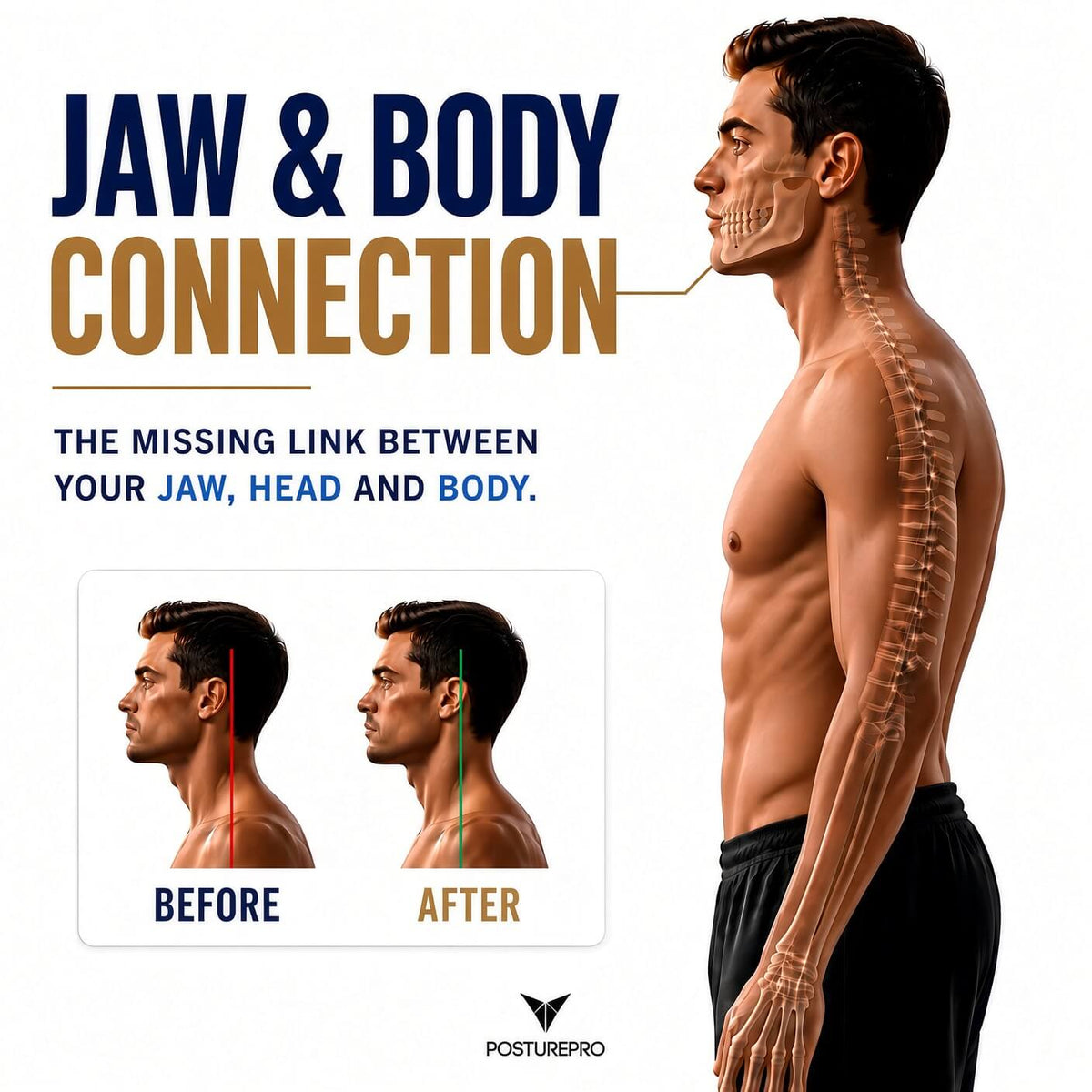
- ✓ Understand how jaw position, tongue function, and muscle tension can influence posture and body alignment.
- ✓ Explore the neurological connections between your jaw, neck, spine, and nervous system.
- ✓ Learn practical assessments and techniques to identify jaw imbalances and understand their influence on the rest of your body.
Frequently Asked Questions
Can jaw misalignment affect posture?
Yes. Your brain uses the position of your jaw as one of its references when it organizes your posture, so a jaw that sits off center or stays clenched changes how your head, neck and trunk are held. The Jaw and Body Connection course shows you how jaw position, tongue function and muscle tension can influence your posture and alignment.
How does jaw position affect posture?
Your jaw gives your brain a constant report on where it sits and how hard it is closing. When it sits off center or stays clenched, your brain changes how it holds your head, and your neck, trunk and pelvis adjust to keep you balanced.
Can a misaligned jaw affect your hips or pelvis?
Yes. When your jaw shifts or clenches, your neck and trunk adjust to keep your head level, and your pelvis adjusts to everything above it. That is why an uneven bite and an uneven pelvis so often show up together, and why hip tightness keeps returning while the jaw pattern stays the same.
Does clenching your jaw affect your posture?
Strong clenching switches on the neck muscles and recruits the muscles along the spine and abdomen. An occasional clench is normal, but a jaw that braces every time you stand up, lift or concentrate keeps those muscles working far more than they need to.
Are jaw problems and lower back pain connected?
They often show up together, because your jaw and your lower back are organized as one pattern by the same nervous system. A jaw that braces all day keeps your neck and trunk working with it, and that tension does not stop at your neck.
What is a jaw muscle imbalance?
A jaw muscle imbalance is when the muscles on one side of your jaw do more of the work than the other. It can come from a favorite chewing side, a bite that shifts the jaw, or clenching more on one side. Because your brain uses jaw position when it organizes posture, the imbalance does not stay in your face.
How can I tell which side of my jaw is stronger?
Notice which side you chew on without thinking about it. Most people favor one side, and that habitual side does more of the work. What matters is whether you can use both sides comfortably, or whether one side carries nearly everything.
Can you realign your jaw to fix your posture?
Forcing your jaw into a new position on its own rarely holds, because your brain keeps returning to the pattern it knows. Lasting change comes from changing how your brain organizes your jaw, neck and trunk together, which is the focus of the Posturepro approach.
Why does tension keep coming back after a massage or adjustment?
Massage and adjustments change the tissue that is tight, which is why they bring real relief. If the reason your brain was holding that tension has not changed, including what your jaw is doing, it rebuilds the same pattern.
References
- Penfield, W., & Boldrey, E. (1937). Somatic motor and sensory representation in the cerebral cortex of man as studied by electrical stimulation. Brain, 60(4), 389-443. doi:10.1093/brain/60.4.389
- Eriksson, P. O., Häggman-Henrikson, B., Nordh, E., & Zafar, H. (2000). Co-ordinated mandibular and head-neck movements during rhythmic jaw activities in man. Journal of Dental Research, 79(6), 1378-1384. PMID 10890716
- Herzog, J., Göttfert, F., Maurer-Grubinger, C., Holzgreve, F., Oremek, G., Groneberg, D. A., & Ohlendorf, D. (2022). Improvement of cervical spine mobility and stance stability by wearing a custom-made mandibular splint in male recreational athletes. PLoS One, 17(12), e0278063. PMC9754227
- Ehrlich, R., Garlick, D., & Ninio, M. (1999). The effect of jaw clenching on the electromyographic activities of 2 neck and 2 trunk muscles. Journal of Orofacial Pain, 13(2), 115-120. PMID 10425983
- Zurita-Hernandez, J., Ayuso-Montero, R., Cuartero-Balana, M., Willaert, E., & Martinez-Gomis, J. (2020). Relationship between unilateral posterior crossbite and human static body posture. International Journal of Environmental Research and Public Health, 17(15), 5303. PMC7432746