


In this article
These 8 simple eye training exercises can be done at home without any special equipment. Whether you're dealing with digital eye strain or want to maintain healthy vision, these proven exercises will help improve your eye coordination, reduce fatigue, and enhance your overall visual performance.
Eye exercises work by strengthening the muscles that control eye movement and improving the connection between your eyes and brain. Regular practice can lead to better focus, reduced eye strain, and improved visual tracking abilities.
The Science Behind Eye Training
Eye movements play a crucial role in our brain's neural pathways. These movements can influence the dopaminergic system, which regulates dopamine levels in the brain. Dopamine is a neurotransmitter that affects reward, motivation, and alertness. Understanding this connection helps explain why proper eye training can benefit both your vision and cognitive function.
For those dealing with specific vision issues like convergence insufficiency, the NeuroVision course offers targeted eye movement training.
Go deeper: 8 eye exercises that instantly improve focus and posture (free e-book inside with the Posturepro+ subscription).
8 Effective Eye Training Exercises for Focus and Strain
1. Palming Technique

The palming technique is excellent for relaxing your eyes and reducing stress. This exercise helps relieve eye fatigue and promotes relaxation.
How to do it:
- Sit comfortably and rub your palms together to create warmth
- Close your eyes and gently place your palms over them without applying pressure
- Imagine complete darkness and take deep breaths
- Hold this position for 2-3 minutes
2. Focus Change Exercise

Focus change is a simple yet effective exercise that improves your focusing ability and eye coordination.
How to do it:
- Hold your thumb about 10 inches away from your face and focus on it
- Slowly move your thumb away while maintaining focus
- Shift your focus to an object about 15 feet away
- Alternate between focusing on your thumb and the distant object for 1-2 minutes
3. Figure Eight Exercise

The figure eight exercise enhances your eye flexibility and control, improving your eye tracking ability and coordination.
How to do it:
- Imagine a large figure eight about 10 feet in front of you
- Trace the shape with your eyes slowly and steadily
- After one minute, switch directions
- Continue for 2-3 minutes total
4. Near and Far Focus

This beneficial exercise strengthens your eye muscles and improves your ability to shift focus quickly and efficiently.
How to do it:
- Sit comfortably and hold your thumb about 10 inches from your face
- Focus on your thumb for a few seconds
- Shift your focus to an object 10-20 feet away
- Alternate between your thumb and the distant object for several repetitions
- Continue for 2-3 minutes
5. Eye Rolling Exercise

Eye rolling is a straightforward exercise that helps relax your eye muscles and improve blood circulation.
How to do it:
- Sit comfortably and close your eyes
- Slowly roll your eyes in a circular motion, first clockwise
- Then roll counterclockwise
- Perform this exercise for about one minute
6. Blinking Exercise
Blinking helps reduce dryness and strain, keeping your eyes comfortable and hydrated, especially during digital device use.
How to do it:
- Set a timer for two minutes
- Blink every four seconds deliberately
- Make each blink slow and complete
- This exercise helps combat digital eye strain
7. Pencil Push-Ups
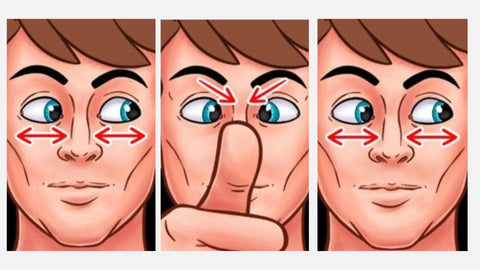
Pencil push-ups are excellent for improving your eye convergence and strengthening eye muscles for close-up focus. They are the most widely used of the convergence exercises, the drills that train both eyes to aim together at a near target.
How to do it:
- Hold a pencil at arm's length and focus on its tip
- Slowly bring the pencil towards your nose while maintaining focus
- Once you see a double image, move the pencil back to starting position
- Repeat this exercise 10 times
8. Zooming Exercise

The zooming exercise helps improve your focus and eye coordination at varying distances.
How to do it:
- Hold your thumb at arm's length and focus on it
- Slowly bring your thumb closer to your face while keeping focus
- Stop when your thumb is about three inches from your nose
- Move it back to arm's length
- Repeat for 1-2 minutes
Additional Tips for Better Results
Short, consistent sessions beat long occasional ones. A few minutes in the morning, plus quick resets during screen time, keeps the eye muscles coordinated without fatiguing them. Match the exercises to your day: palming and blinking when the eyes feel tired, focus shifts and pencil push-ups when you want to sharpen near work. Treat them as eye muscle exercises in the same way you would any other training: light, regular, and progressive.
For those interested in more sophisticated eye training, the NeuroVision course offers eye movement techniques that rewire brain-posture control.
Understanding Eye Movement and Brain Function
Eye exercises don't just strengthen your visual system, they also support cognitive function. The connection between eye movements and brain activity is particularly evident in vertical eye movements, which can influence dopamine pathways. This fascinating connection shows how proper eye training can benefit both vision and overall neurological health.
The Brainpro App
Train your brain. With your eyes. That is the idea behind Brainpro, the Posturepro app that turns this kind of eye training into a guided daily routine: four exercises, five minutes a day, no equipment.
Each session uses eye movements to target specific brain areas to improve posture, balance, and coordination. A target dot leads your eyes through each drill while your head stays still, so the exercises you read about above come with pacing, progression, and a routine that fits into the time it takes to brush your teeth.
What each drill trains, and what a session actually looks like, is laid out on the Brainpro eye training app site. Brainpro is available for iPhone on the App Store.
When to Expect Results

Most people notice results almost immediately because the right visual feedback instantly recalibrates how the brain organizes posture, focus, and movement. When the eyes send clear, accurate information, the nervous system responds in real time. You feel it in your posture, your mood, and even how grounded you are. That's the power of targeting the root, not the symptom.
Conclusion
Regular eye training exercises are a simple, effective way to improve your vision naturally. By incorporating these 8 exercises into your daily routine, you can reduce eye strain, strengthen your eye muscles, and enhance your overall visual performance.
Remember that vision problems can sometimes indicate underlying posture issues. Eye position drives head position, so training the eyes well tends to show up in how the whole body carries itself.
Start with just 5-10 minutes daily and gradually increase as these exercises become part of your routine. Your eyes will thank you for the investment in their health and performance.

Take your eye training further
- ✓ Structured eye movement training, step by step
- ✓ Builds focus, tracking, and visual efficiency
- ✓ Self-paced online course, practiced at home
Frequently Asked Questions
How often should I do these eye exercises?
Aim for 1 to 3 minutes daily, preferably in the morning. You can also do shorter sessions throughout the day.
Can vertical eye exercises improve my vision?
While eye exercises don't change the anatomical aspects of the eye responsible for refractive errors, they can improve the strength and coordination of your eye muscles, leading to better control over eye movements and reduced strain.
Can eye exercises help with eye strain from computer use?
Yes, regular practice of eye exercises can help alleviate eye strain caused by prolonged computer use. They help improve eye muscle coordination and reduce fatigue.
Can children do these exercises?
Yes, these exercises are safe for children and can be particularly beneficial for developing proper eye coordination.
What is eye training?
Eye training is the practice of working the muscles and coordination patterns that control eye movement: focusing, tracking, converging, and shifting between near and far. The goal is smoother, more efficient eye movement and less strain, not a change to the shape of the eye itself.
Do eye exercises really improve vision?
Eye exercises improve the performance of the visual system: focus speed, tracking, coordination between the two eyes, and comfort during long visual work. They do not correct refractive errors like nearsightedness, so be cautious of anyone promising to eliminate glasses. What they reliably improve is how well your eyes work together.
How long does it take for eye training to work?
Relief from strain often shows up within the first sessions, because relaxing and coordinating the eye muscles has an immediate effect. Steadier gains in focus and tracking usually build over several weeks of short daily practice.
Why does eye training affect posture?
Eye position drives head position, and head position shapes the posture of everything below it. When the eyes track and focus more efficiently, the head has a reason to sit balanced over the shoulders, which is why vision work and posture so often improve together.
Do these eye exercises to improve vision actually work?
As eye exercises to improve vision, they work on the functional side: focus speed, tracking, and how well the two eyes coordinate. They will not reshape the eye or undo a refractive error, but the functional gains are what most people actually notice as clearer, more comfortable vision through the day.
What are the best eye exercises for eye strain?
The best eye exercises for eye strain are palming and deliberate blinking, because they relax the eye muscles and restore moisture. Add focus changes and the 20-20-20 habit during screen work to keep the strain from rebuilding.
Is this eye training the same as vision training or visual therapy?
Yes, the terms overlap. Eye training, vision training, and visual therapy all describe working the muscles and coordination patterns that control eye movement. These vision therapy exercises are the at-home version; clinical programs apply the same principles with professional supervision.
Can eye training improve eyesight?
Eye training can improve how your eyesight performs: sharper focus shifts, steadier tracking, and less strain. It does not correct refractive errors like nearsightedness, so glasses prescriptions stay the same. What changes is how efficiently your eyes work within the vision you have.
References
- Hikosaka, O., & Wurtz, R. H. (1985). Modification of saccadic eye movements by GABA-related substances. Journal of Neurophysiology, 53(2), 266-291. doi:10.1152/jn.1985.53.2.266
- Schultz, W. (1998). Journal of Neurophysiology, 80(1), 1-27. doi:10.1152/jn.1998.80.1.1
- Leigh, R. J., & Kennard, C. (2004). Using saccades as a research tool in the clinical neurosciences. Brain, 127(3), 460-477. doi:10.1093/brain/awh035