


In this article
Why Sitting Is Destroying Your Posture (And the 5-Minute Fix That Actually Works)
Quick Stats: A substantial portion of the population is affected by posture-related issues. The average office worker's head is 2-3 inches forward, effectively doubling the weight their neck muscles must support.
It's 2:30 PM. Your neck feels like someone's driving a nail through it. Your shoulders have migrated somewhere near your ears, and there's a persistent ache in your lower back that started the moment you sat down this morning. You shift in your chair, again, trying to find that mythical "comfortable position" that seems to last about 30 seconds before the discomfort creeps back in.
Sound familiar?
If you're reading this hunched over your laptop right now (quick, straighten up!), you're experiencing firsthand what a substantial portion deal with every single day: the slow, systematic destruction of your natural posture by the very chair you're paid to sit in.
But here's what your company wellness program won't tell you: this isn't just about comfort. Poor posture for office workers is silently sabotaging your energy, focus, confidence, and long-term health in ways that go far beyond a sore back.
Key Insight: Poor posture affects more than just physical comfort: it impacts your breathing, energy levels, cognitive function, and even your confidence in professional situations.
Related Reading: The Complete Guide to Ergonomic Office Setup
The Hidden Cost of Sitting: What Bad Posture Is Really Stealing From You

It's Not Just Physical Pain, It's Your Life Force
When you think about sitting posture problems, you probably think about back pain. But that's just the tip of the iceberg. Poor posture is a silent thief, stealing from you in ways you might not even realize:
Your Energy: That 3 PM crash isn't just about lunch. When your spine is compressed and your chest is collapsed from slouching at a computer, your diaphragm can't fully expand. You're literally getting less oxygen to your brain and muscles. No wonder you feel exhausted by Wednesday.
Your Confidence: Studies show that people with slouched posture report feeling less confident, less assertive, and more anxious. When you can't physically stand tall, you don't feel tall either. This affects everything from your next presentation to your salary negotiations.
Your Focus: Forward head posture (that crane-like position where your head juts forward from your shoulders) creates tension in your cervical spine that directly impacts brain function. The constant strain literally makes it harder to think clearly.
Your Mood: Poor posture compresses your thoracic cavity, affecting your heart rate variability and stress response. This is why you feel more irritable and overwhelmed when you're hunched over your desk all day.
Research Finding: For every inch your head moves forward from its ideal position, it effectively doubles in weight on your neck muscles, from 10-12 pounds to 20-30 pounds.
The Domino Effect: How Your Desk Job Creates a Chain Reaction of Dysfunction

Here's the brutal truth about desk posture correction: your body is designed to move, not to hold a static position for 8+ hours. When you force it into the unnatural position of sitting, everything starts to break down:
- Your hip flexors shorten and tighten from constant 90-degree flexion
- Your glutes "turn off" from chronic underuse (gluteal amnesia is a real thing)
- Your thoracic spine rounds as your chest muscles tighten and your upper back weakens
- Your head moves forward as you lean toward your screen
- Your shoulders roll inward as your upper traps overcompensate for weak deep neck flexors
Critical Timeline: This cascade begins within the first hour of sitting and compounds with every passing day. It's not a gradual process happening over years.
The Posture Myths That Keep You Stuck (And Why "Sit Up Straight" Doesn't Work)
Myth #1: "Just Remember to Sit Up Straight"
If willpower worked, you wouldn't be reading this article. The problem with "conscious posture correction" is that your brain has more important things to worry about than monitoring your shoulder position every second of the day.
The Reality: You need systematic muscle retraining, not constant mental reminders.
Myth #2: "An Expensive Ergonomic Chair Will Fix Everything"
The ergonomic office furniture industry is worth billions, yet neck and shoulder pain from office work continues to rise. Why? Because ergonomic chairs address symptoms, not root causes.
The Reality: No chair can fix shortened hip flexors, weak glutes, and a forward head posture that's been developing for years.
Myth #3: "I Don't Have Time for Exercise at Work"
This is the biggest myth of all. The idea that you need an hour-long gym session to address sitting posture problems is what keeps most people stuck in pain.
The Reality: The most effective posture exercises for office workers take just minutes and can be done right at your desk.
Time Reality Check: Research shows that targeted 3-7 minute interventions throughout the workday are more effective than longer exercise sessions after work.
The Real Culprits: What's Actually Destroying Your Posture (It's Not What You Think)
It's Not Your Chair, It's Your Movement Patterns
Everyone obsesses over finding the "perfect chair," but that's missing the point entirely. The issue isn't what you're sitting in; it's how long you're sitting and what that's doing to your movement patterns.
When you sit for extended periods:
- Your brain "forgets" how to properly activate your postural muscles
- Your body adapts to the chair's shape, not its natural alignment
- Your proprioception (body awareness) becomes dulled
- Your postural reflexes weaken
The Forward Head Posture Epidemic
Forward head posture from sitting isn't just unsightly, it's biomechanically devastating. For every inch your head moves forward from its ideal position over your shoulders, it effectively doubles in weight on your neck muscles.
The average office worker's head is 2-3 inches forward, meaning their neck muscles are supporting 20-30 pounds instead of the normal 10-12 pounds. No wonder you have constant tension.
The Hip Flexor Time Bomb
Your hip flexors (the muscles that connect your spine to your thighs) are designed for walking, not sitting. When you sit for hours, they adapt by shortening and tightening. This pulls on your lower back and tilts your pelvis forward, creating that "duck butt" posture that leads to chronic back pain.
The Breathing Connection No One Talks About
Here's something most people don't realize: poor posture directly impacts your breathing. When your chest collapses and your shoulders round forward, your diaphragm can't function properly. You end up breathing shallowly into your chest instead of deeply into your belly.
This chronic shallow breathing keeps your nervous system in a state of low-level stress, which explains why you feel anxious and fatigued even on "easy" days at the office.
Learn More: Breathing Exercises for Office Stress Relief | Complete Workplace Wellness Guide
Why Everything You've Tried Has Failed (And It's Not Your Fault)
The Temporary Fix Trap
Maybe you've tried stretching your neck when it gets tight. Or rolling your shoulders back when you remember. Perhaps you even bought a standing desk converter or a lumbar support cushion.
These aren't bad things, but they're band-aids on a bullet wound. They provide temporary relief without addressing the underlying muscle imbalances and movement patterns that created the problem in the first place.
The "No Time" Reality Check
Most posture exercises for office workers you find online require 30-60 minutes of your day. Between commuting, working, family obligations, and trying to maintain some semblance of a social life, who has time for an hour of corrective exercises?
This is why most people start with good intentions but quit within a week or two. The solution has to fit into your actual life, not the life you wish you had.
Information Overload Paralysis
Google "how to fix posture while working at a desk" and you'll get 50 million results with conflicting advice. One site says to stretch your hip flexors, another says to strengthen them. One expert recommends a standing desk, another warns they can cause different problems.
When you're drowning in contradictory information, it's easier to do nothing than to risk doing the wrong thing.
The Problem: Most solutions are either too time-consuming for busy professionals or provide conflicting advice that leads to paralysis rather than action.
If hours of sitting leave your neck, shoulders, and lower back stuck in the same slumped pattern day after day, you need a fix that fits into your workday, not another hour-long workout.
5 Minute Posture Fix
Improve Your Desk Posture in Just 5 Minutes a Day
Working at a Desk All Day? Stop Letting Your Posture Pay the Price.
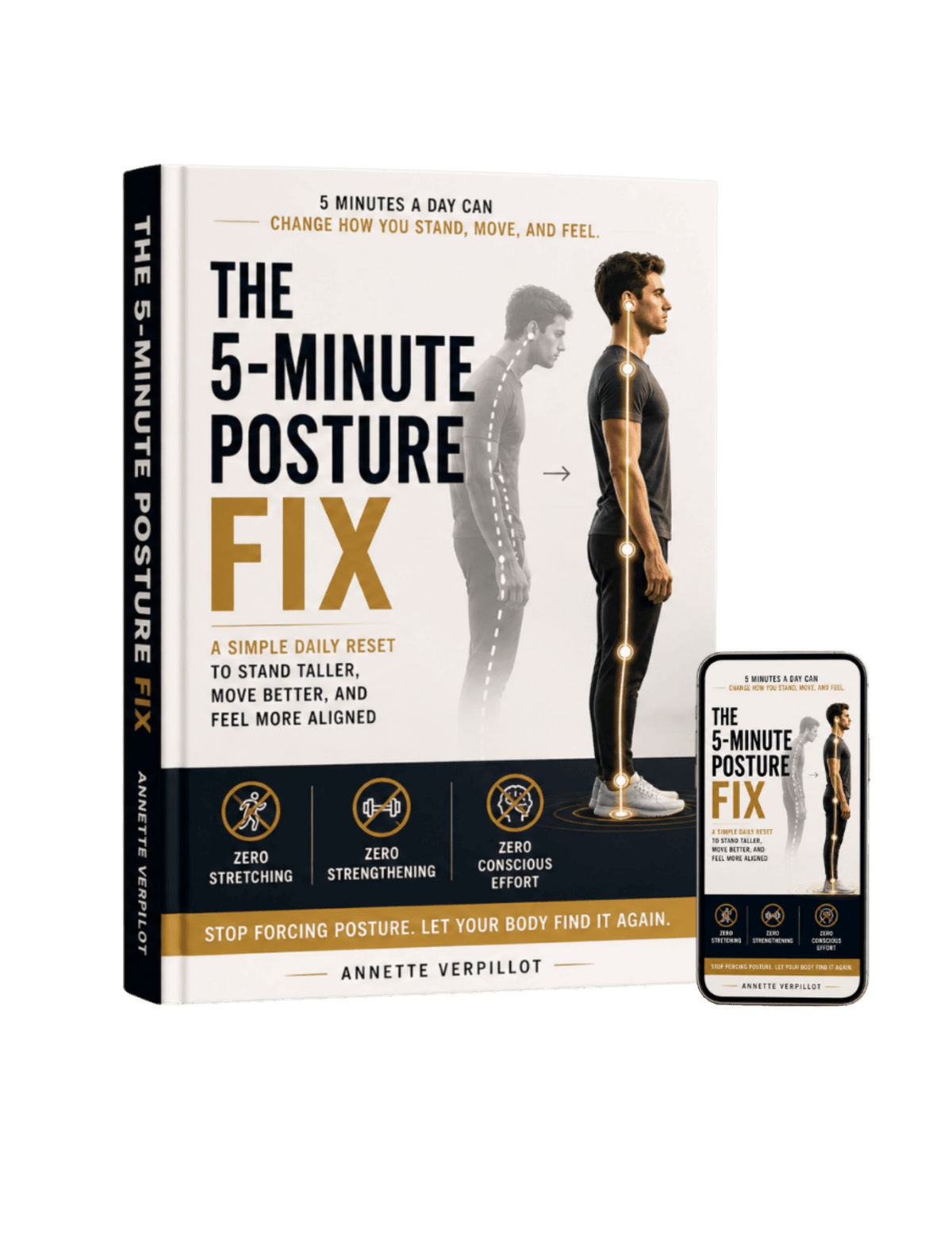
- ✓ Help reduce rounded shoulders and forward head posture caused by long hours sitting at a computer.
- ✓ Follow a simple, guided 5 minute routine designed for people who work from home or spend their days at a desk.
- ✓ Improve your posture without spending hours exercising, buying equipment, or constantly reminding yourself to sit up straight.
The Science-Backed Solution: What Actually Works for Office Workers

The 5-Minute Revolution
What if I told you that the most effective posture for office workers correction doesn't require a gym membership, expensive equipment, or even getting out of your work clothes?
The breakthrough isn't in doing more; it's in doing the right things in the right order for just the right amount of time.
Research Breakthrough: Recent studies in occupational health show that targeted, brief interventions throughout the workday are more effective than longer exercise sessions after work.
Your body needs frequent "posture breaks" to reset, not marathon correction sessions.
The Movement Quality Breakthrough
Traditional approaches focus on stretching tight muscles and strengthening weak ones. But there's a missing piece: movement quality. You can stretch your hip flexors and strengthen your glutes, but if your brain doesn't remember how to coordinate them properly, you'll revert to old patterns within hours.
Effective desk posture correction requires neurological reprogramming: teaching your nervous system new, healthier movement patterns that become automatic.
The Compound Movement Solution
Instead of isolated stretches and exercises that target one muscle at a time, the most effective approach uses compound movements that address multiple postural issues simultaneously.
For example, a single exercise can:
- Release tight hip flexors
- Activate dormant glutes
- Improve thoracic spine mobility
- Strengthen deep neck flexors
- Reset your breathing pattern
This is why a well-designed 5-minute posture routine can be more effective than an hour of random stretches.
Efficiency Principle: One properly designed compound movement that addresses multiple postural problems simultaneously is more effective than multiple isolated exercises.
The 5-Minute Posture Fix: Your Fast-Track to Pain-Free Office Life

Why 5 Minutes Is the Sweet Spot
Research shows that it takes approximately 3-7 minutes of targeted movement to:
- Reset shortened muscles
- Activate inhibited muscles
- Restore proper joint positioning
- Calm an overactive nervous system
More importantly, 5 minutes is sustainable. It's short enough that you'll actually do it consistently, but long enough to create real physiological change.
Next Steps: Understanding the problem is the first step. The real transformation happens when you implement a systematic, science-backed approach that fits into your busy work schedule. Small, consistent actions compound into significant improvements in how you feel and perform throughout your workday.
If your sitting posture keeps collapsing the moment your attention shifts, the resting pattern your brain defaults to is the part that needs correcting.
5 Minute Posture Fix
Improve Your Desk Posture in Just 5 Minutes a Day
Working at a Desk All Day? Stop Letting Your Posture Pay the Price.
- ✓ Help reduce rounded shoulders and forward head posture caused by long hours sitting at a computer.
- ✓ Follow a simple, guided 5 minute routine designed for people who work from home or spend their days at a desk.
- ✓ Improve your posture without spending hours exercising, buying equipment, or constantly reminding yourself to sit up straight.
Frequently Asked Questions About Office Worker Posture
What causes rounded shoulders and forward head posture?
Long hours of sitting set off a chain reaction. Your thoracic spine rounds as your chest muscles tighten and your upper back weakens, your head moves forward as you lean toward your screen, and your shoulders roll inward as your upper traps overcompensate for weak deep neck flexors.
How long does it take to fix forward head posture?
Many people notice reduced tension within the first week of consistent practice, and significant postural changes typically occur within 2-4 weeks. Because forward head posture builds up over years, the change lasts when the underlying muscle imbalances and movement patterns are retrained, not just stretched.
How quickly can I see results from posture exercises?
Many people notice improved energy and reduced tension within the first week. Significant postural changes typically occur within 2-4 weeks of consistent practice.
Can I do posture exercises at my desk without anyone noticing?
Yes! The most effective desk posture exercises are designed to be done subtly during your normal work routine, including while reading emails or during meetings.
Is forward head posture reversible?
Absolutely. With consistent targeted exercises that address the underlying muscle imbalances and movement patterns, forward head posture can be significantly improved and often completely corrected.
Why don't ergonomic chairs solve posture problems?
Ergonomic chairs address symptoms but not root causes. They can't fix shortened hip flexors, weak glutes, or the neurological patterns that cause poor posture. The solution requires active movement and muscle retraining.
How does poor posture affect productivity at work?
Poor posture reduces oxygen to the brain, creates physical discomfort that's distracting, increases fatigue, and can negatively impact confidence, all of which significantly reduce work performance and productivity.
How do you sit with good posture at a desk?
Proper sitting posture at a desk means feet flat on the floor, knees at about 90 degrees, your lower back supported by the chair, shoulders relaxed, and the top of your screen at eye level so your head stays balanced over your shoulders instead of drifting forward.
How do you fix your sitting posture?
Fix the setup first, then the habit. Adjust your chair, screen, and keyboard to neutral positions, then reset your position regularly through the day. If your sitting posture keeps collapsing the moment your attention shifts, the resting pattern your brain defaults to is the part that needs correcting, not just the furniture.
